
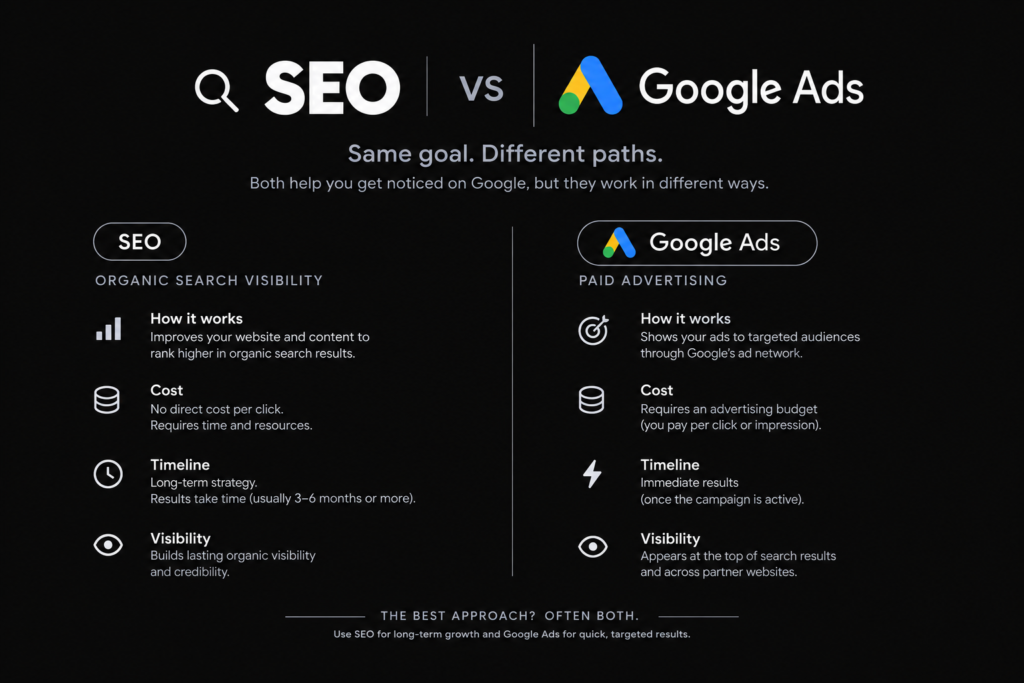
When businesses want to increase their visibility on Google, two common strategies they consider are SEO and Google Ads. Both can help businesses reach people searching online, but they work in different ways. Understanding how SEO and Google Ads differ can help business owners choose a marketing strategy that matches their goals, budget, competition, and timeline.
What Is SEO?
SEO stands for Search Engine Optimization. It involves improving a website and its content so that search engines can better understand the pages and potentially show them in relevant organic search results.
SEO can include keyword research, content creation, technical optimization, on-page optimization, internal linking, local SEO, website improvements, and earning relevant links from other websites.
For example, if you offer web design services, you might create a detailed page about web design services and supporting blog content answering questions that potential customers commonly search for. Over time, this content can help your website build organic visibility for relevant searches.
What Is Google Ads?
Google Ads is Google’s online advertising platform. Businesses can create paid campaigns to advertise their products and services to relevant audiences. Depending on the campaign type, advertisements can appear across Google’s search and advertising network.
Search advertising can be useful when a business wants to reach people who are actively searching for particular products or services. For example, a business offering digital marketing services could create an advertising campaign around relevant search terms.
Unlike organic SEO traffic, Google Ads involves an advertising budget. Businesses can control campaign settings such as budget, targeting, keywords, advertisements, and landing pages.
The Main Difference Between SEO and Google Ads
The biggest difference is that SEO focuses on organic search visibility, while Google Ads provides paid advertising opportunities.
With SEO, businesses invest time and resources into improving their website and content. With Google Ads, businesses pay for advertising campaigns according to the campaign structure and user interactions.
SEO generally requires patience because building organic visibility can take time. Google Ads can provide paid visibility once campaigns are active and eligible to serve, although actual performance depends on factors such as targeting, competition, ad quality, budget, landing-page experience, and other campaign factors.
SEO Can Support Long-Term Visibility
SEO is often considered a long-term digital marketing strategy. A useful article or well-optimized service page can continue attracting visitors from search engines after it has been published.
However, SEO is not a one-time task. Search behavior, competitors, content, algorithms, and business priorities can change. Websites need to be reviewed and updated regularly to maintain their relevance and quality.
Google Ads Can Support Immediate Campaign Goals
Google Ads can be useful when a business wants to promote a specific service, product, offer, or campaign. Instead of waiting for a new page to build organic visibility, a business can use paid advertising to reach selected search audiences.
For example, a business launching a new service could use Google Ads to promote a dedicated landing page while simultaneously developing an SEO strategy for long-term organic visibility.
Which One Should Your Business Use?
There is no single strategy that works for every business. The right approach depends on factors such as your marketing goals, industry, competition, budget, target audience, website quality, and timeline.
A new business that needs targeted traffic for a specific campaign may consider paid advertising. A business focused on building long-term organic visibility may invest more heavily in SEO. Businesses with sufficient resources may use both strategies as part of a broader digital marketing plan.
Using SEO and Google Ads Together
SEO and Google Ads do not have to be treated as competing strategies. They can work together.
For example, Google Ads can help a business generate targeted traffic while the business develops its organic search presence through SEO. Data from advertising campaigns can also provide useful insights into customer search behavior and messaging that may help inform content strategies.
At the same time, strong organic content can support a website’s overall online presence and provide additional opportunities to attract visitors through search engines.
Consider the Customer Journey
The best digital marketing strategy should consider what happens after someone clicks on a search result or advertisement. Getting visitors to your website is only one part of the process.
Your website should clearly explain your services, answer important questions, build credibility, and make it easy for visitors to take the next step. This could include contacting your business, requesting a quote, booking a consultation, purchasing a product, or submitting an inquiry.
Track and Improve Your Results
Whether you use SEO, Google Ads, or both, tracking performance is important. Useful measurements can include website traffic, impressions, clicks, leads, conversions, engagement, and other business-specific metrics.
Regular analysis can help identify which pages, keywords, advertisements, and campaigns are contributing to your goals. Based on this information, you can make improvements to your website and marketing strategy.
Final Thoughts
SEO and Google Ads are different approaches to increasing online visibility, but both can play a valuable role in a digital marketing strategy. SEO focuses on building organic search visibility through website and content improvements, while Google Ads provides paid opportunities to reach targeted audiences.
Instead of viewing SEO and Google Ads as an either-or decision, businesses can consider how both strategies might support different stages of their marketing goals. A combination of organic content, paid advertising, a professional website, and consistent performance analysis can create a more complete approach to digital marketing.
What Is Digital Marketing? A Beginner’s Guide
Why Digital Marketing Matters for Every Business
Think about the last time something at home broke. The AC, a leaking tap, whatever. Did you ask someone for a number? Most people don’t. They pick up the phone, search, scan the top few results, and call the one with decent reviews. Two minutes, maybe less.
Now flip it around. If you run a clinic, a studio, or a shop, you want to be one of those names. If you’re not, the customer never even knew you existed. Doesn’t matter how good you are at your job.
That’s digital marketing. Getting found online, and looking trustworthy once you are. Google, Instagram, WhatsApp, email, ads, all of it. And a small business can hold its own here. A filled-in Google Business Profile, a phone that gets picked up, and some real reviews from real customers will already put you ahead of a surprising number of bigger competitors.
The Main Types of Digital Marketing
SEO is how you show up on Google without paying per click. It’s slow, and there’s no way around that. Give it three to six months before judging it. But a page that ranks keeps working long after you’ve published it.
Content marketing is just answering questions. What do customers keep asking you on calls? A dentist gets “does a root canal hurt?” about fifty times a month. Write that post. Someone is searching for exactly that right now.
Social media means Instagram, Facebook, YouTube, LinkedIn and the rest. Nobody needs all of them. A restaurant should probably be on Instagram. A software consultant is better off on LinkedIn.
Email sounds old, and people keep declaring it dead, but it keeps working. The list is yours. If a platform changes its rules next week, your subscribers are still your subscribers.
Paid ads (Google Ads, Meta Ads) charge you per click. You get visitors fast, which is handy for a launch or a festival offer. The catch is that money disappears quickly when nobody’s watching the campaign. Start small and check it often.
Influencer and affiliate marketing is paying someone with an audience, or giving them a commission, to talk about you. It works because we trust people more than brand logos.
How These Channels Work Together
Almost nobody buys after one post. More likely, a customer sees your Reel and keeps scrolling. Two weeks later she searches your name, reads a blog post, and joins your WhatsApp list because there’s a discount. Then your reminder message arrives and she finally buys.
Four channels, five touches, one sale. So “which channel is best?” isn’t a very useful question. Ask which ones your own customers actually pass through.
How to Get Started With Digital Marketing
Pick one goal. Calls, walk-ins, or online orders. Just one, for now.
Write down who your customer is. Age, problem, budget, where they hang out online. Three lines is enough. Seriously.
Open your website on your phone. Does it load fast? Can you find the phone number without hunting? If not, fix that before spending anything on ads. Sending people to a bad website is a waste of money.
Start small. A Google Business Profile and one social platform will keep you busy for the first three months.
Set a budget you can afford to lose. A few thousand rupees a month is enough to learn what works. Spend more once you’ve seen results, not before.
How to Measure Your Results
Set up Google Analytics and Google Search Console. Both are free. Once a month, look at how many people visited, where they came from, and how many actually got in touch.
Big view counts feel great, but they can mislead you. A post with 5,000 views and zero enquiries is worth less than one with 200 views and three phone calls. Write your numbers down every month, even in a notebook. After three months you’ll spot patterns you’d never notice otherwise.
Common Beginner Mistakes to Avoid
- Being on six platforms and doing all of them badly
- Not deciding on a goal, then feeling like nothing’s working
- Building a website on a laptop and never checking it on a phone
- Quitting after three weeks, when most channels need a few months
- Copying a competitor without asking if their customers are like yours
Conclusion
You don’t have to do everything, and you shouldn’t try. Pick a goal, start with one or two channels, and look at your numbers every month. When something works, add the next thing.
If you’d like help deciding where to start, contact us for a free consultation.